"The best gift parents can ever give to their children is to love each other." Unknown

Friday, July 24
Quote of the day (QOTD)


Thursday, July 23
2 questions
Something to ponder on:
Question 1: Have you experienced joy in your life?
Question 2: Have you brought joy to others?
Source:

the movie - The Bucket List
Quote:
Question 1: Have you experienced joy in your life?
Question 2: Have you brought joy to others?
Source:
the movie - The Bucket List
Quote:
You measure yourself by the people who measure themselves by you. ~Carter Chambers
Wednesday, July 22
The Science of Parenting: Crying and separation
It is one of the hardest things - to see the baby cries especially when it is our own. It often makes the parent feels helpless and that is an awful secondary feeling. Not only is prolonged crying is hard to bear, it is also bad for the baby. The chapter on crying and separation in this book shows how stress from prolonged crying and separations can affect baby's developing brain. If you forget everything else, please do remember that crying is your baby's intense bid for you to help her with her overwhelming feelings and frightening bodily sensations. This is because her brain in not yet developed enough for her to manage them on her own.
Why do babies cry??!!
The most important thing you can do
What happens in the brain when babies cry?
The science of comforting.
How to soothe your baby?
Do things that will stimulate the anti-stress chemical system in the brain.
Separations and time apart.
Childcare issue
The NEED to cling. Why?
I learn best when I reproduce what I have read so this serves my need. I don't mind sharing the information but again if you can afford the time it is best that you pick up the book.
Science of parenting part one is here
P.S. Your discretion is advised.
Why do babies cry??!!
- Babies are sensitive, raw and vulnerable to stress.
- They cry for various reasons - tiredness, hunger, over- or under-stimulated, fear of threats or shocks, the environment is not conducive - too bright, too harsh, too cold, too hot, too sudden and so on.
- Amygdala, which is important alarm system in the lower brain, is perfectly on line at birth. Its main function is to work out the emotional meaning of everything that happens. When it senses that something threatening is happening, it communicates to hypothalamus, which then control the release of stress hormones which can then prepare the body for fight or flight.
- Babies need help in managing this awful feeling. If they are left to manage this on their own, the higher brain may not develop the necessary wiring to be able to perform these stress managing functions. As a result, they may stay feeling stressed for hours or even longer. Without intervention from the caregivers, the brain's key response systems are in danger of being permanently wired as "over-active". The consequence of this is that they grow up having trouble turning off the over-sensitive alarm systems of the lower brain.
The most important thing you can do
- Calm down a crying baby and avoid prolonged crying.
- You also need to have the mental and emotional space in your mind to really hear and take her panic and pain seriously.
- Older babies are awash with new feelings especially when they experience panicky separation distress and when they are increasingly clear about likes and dislikes, what frightens or displeases them. Since they are not able to communicate in language yet, they cry to express their needs.
What happens in the brain when babies cry?
- When babies cry, the stress hormone - cortisol- is released by adrenal glands. If the baby is soothed and comforted, the level goes down. If not, it remains high.
- For prolonged period of time, cortisol can reach toxic levels that may damage key structures and systems in a developing brain; as mentioned earlier it would be permanently wired for over-sensitivity.
- Early stress can cause cell death in hippocampus, which is a very important structure in the brain. It shrinks because of cell death within its tissues.
- This could result in chemical imbalances in the brain. Chemicals that are essential for emotional systems are opioids, noradrenaline, dopamine, serotonin and they are still being established in an immature brain.
The science of comforting.
- There are 2 autonomic systems - sympathetic (Aroused) and parasympathetic (Calm & Centered)
- With prolonged crying sympathetic becomes overactive while parasympathetic – VAGUS nerve- becomes under active.
- The more responsive you are, the greater your regulation of her body arousal system will be and the more long-lasting the effects. Many parents are not aware that a child's bodily arousal system is still developing after birth and that it is super sensitive to stressful experiences such as being left to cry on her own.
How to soothe your baby?
Do things that will stimulate the anti-stress chemical system in the brain.
- Touch & Massage
- Sucking is comforting. Help her to find her fist or thumb to suck.
- Only use pacifier when she is utterly inconsolable. Main reason is because mouth is vital for communication and forming of sounds pre-speech. Also vital for oral exploration.
- Use movement & rocking – rhythmical movement resembles the security of the womb
- Low sound eg from washing machine or spin dryer resembles the security of the womb.
- Provide novelty – toys.
- Avoid over stimulation. When baby is over-stimulated bring him to a quiet, low lit room.
Separations and time apart.
- When you need to be separated and the baby cries, you have to take her intense feelings seriously. Do remember that you are her world, her everything, you represent her very safety!
- The separation distress system in a baby is genetically programmed to be hypersensitive. Hence, your baby is NOT being “needy” or “clingy” or difficult or manipulative.
- Because the verbal centres are not online yet, you are not able to tell her that you will be back. Hence, she will not know that you have not gone FOREVER.
- Separation hurts small humans in much the same way as a physical pain. Thus, avoid pushing your children to independence long before they are ready.
- Stress is NOT good for baby. Period.
Childcare issue
- It is important to get a nanny/child minder who adores little children and is great at responding to both joy and distress when you consider childcare.
- Your child needs to be held in familiar arms when you are not there.
- There are evidence to suggest early separations and depression may be linked.
The NEED to cling. Why?
- It is to bring down his bodily arousal level and high levels of stress chemicals.
- Baby is trying to change the emotion chemical imbalance in his brain to a calmer and more positive state.
- This is what research reveals. Mothers who had attended promptly to their crying babies had children who cried much less than those whose mothers had left them to cry. Prolonged clinging is far more likely when a parent has not handled the child's dependency needs well.
- As the child grows, the separation distress in his lower brain naturally become far less sensitive. This is because of the development of the higher brain which inhibits this system.
- Beware of false independence. It is extremely shame-inducing for a child to be in a state of desperate need and he is met with rebuff or criticism or to be told to be a big boy.
- It is tough job. Bear in mind the long term investment that you're making – the long-term anti-stress effects of repeated activation of oxytocin in the brain from all that physical affection. Infants with more loving touch were better able to handle stress and were psychologically stronger.
I learn best when I reproduce what I have read so this serves my need. I don't mind sharing the information but again if you can afford the time it is best that you pick up the book.
Science of parenting part one is here
P.S. Your discretion is advised.
Quote of the day (QOTD)
"I, not events, have the power to make me happy or unhappy today. I can choose which it shall be."
– Groucho Marx
– Groucho Marx
Saturday, July 18
18th July 2009

Another anniversary is here since that fateful day when I decided to go ahead with the first of 2 surgeries to treat a rare illness. 2 years on and I am pleased to share that I am doing very well, I've been asymptomatic and my quality of life has improved tremendously :)
I was reading the journal that I kept during those difficult period and I am impressed with what I wrote in there. The conviction and faith that I had in God was astounding. I almost don't recognize that person. Truly, it was through God's grace that I was able to go through all that I had to - pre and post surgeries.
An excerpt of what I wrote:
I want to remember the feeling - being at peace, cheerful and hopeful. There are lots of things for me to worry about and I could potentially be immobilized by fear. I'm going to take a different strategy- I'd stare fear in the eye. I will deal with it with faith. It's tough but I know I can do it with God's blessing and support from all round. 18 June 07
Who is that person??
I am truly blessed because grace, courage and wisdom came to me when I needed them most. That's the only explanation I can offer as to how I was able to cope with everything. As I have shared earlier I suffered a stroke after my second op on 17 September 07. As a result I lost the ability to read, write, recall, text, tell the time, use the mobile phone and other simple functions that I took for granted. I could only write or type simple sentences and even then it took me a great deal of effort and time.
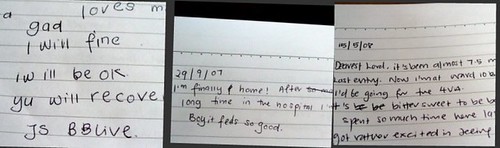
Samples of my handwriting at different stages of recovery - 5-days, 12-days and 7.5 months post-op.
It may not be the politically-correct thing to say but I am grateful that I had the chance to go through what I did. In many ways my illness has shaped and molded me into a better and more mature person. I discovered my own strength- what I am made of. Never in my life did I expect myself to be calm and cheerful in the face of trials and tribulations. Through the experience I was/am reminded that I must not take my life and health for granted. Being ill allowed me to appreciate being cared for. I had lots of people praying and rallying for me and in some ways it was a testimony to the kind of person that I am. I was validated as many people wanted only the best for me and they came in full force to tell me that. That was a great feeling - knowing that you are loved. I believe after being through a recovery process myself it will make me a better (and more credible) clinician and listener.
I am really grateful to my wonderful surgeon and his team - staff who went the extra mile to make me feel more comfortable when I felt most vulnerable. My husband who stood by me every step of the way and being my pillar of strength; my sister and mom who took great care of me; good friends who showed their kindness and generosity; acquaintances and strangers who prayed for the success of the surgeries and speedy recovery. I will always remember the kindness shown to me. Thank you!
My hope is that my story will inspire you to live your life courageously and know that you are stronger and more resilient than you think. Seemingly "bad" situations can turn out to be opportunities for growth and learning if you choose to let go. Somehow when we feel like we have reached the limits we will discover that we can still extend the limits. And grace will find us and give us the special boost to get through life. Trust the process.
Grace expands our intellect by endowing us with intuitive wisdom. Grace expands our will by giving us strength or courage we did not have before.
I'm happy to share more of my experiences so feel free to email me if you want to know more :)
Friday, July 17
Picture of the Week (POTW)

A dog that we saw at one of the beaches along 17-Mile Drive, CA.
Kinda made me miss Casper, our Maltese who is back in Singapore.
Tip of the day
A simple way to start your day on a positive note is to make your bed! There is no faster way to inspire an immediate change in attitude than with an uncluttered, neat and clean bed. A made bed anchors a room, sets the tone for the day, says,"I respect my space," and shows a commitment to routine and organization.
If you haven't have a made bed in a while do give this a try and see for yourself if it works.
Here's to a good start to your day!

Picture is from Bedzine
Idea is from Peter Walsh's book Enough Already!
If you haven't have a made bed in a while do give this a try and see for yourself if it works.
Here's to a good start to your day!
Picture is from Bedzine
Idea is from Peter Walsh's book Enough Already!
Subscribe to:
Posts (Atom)